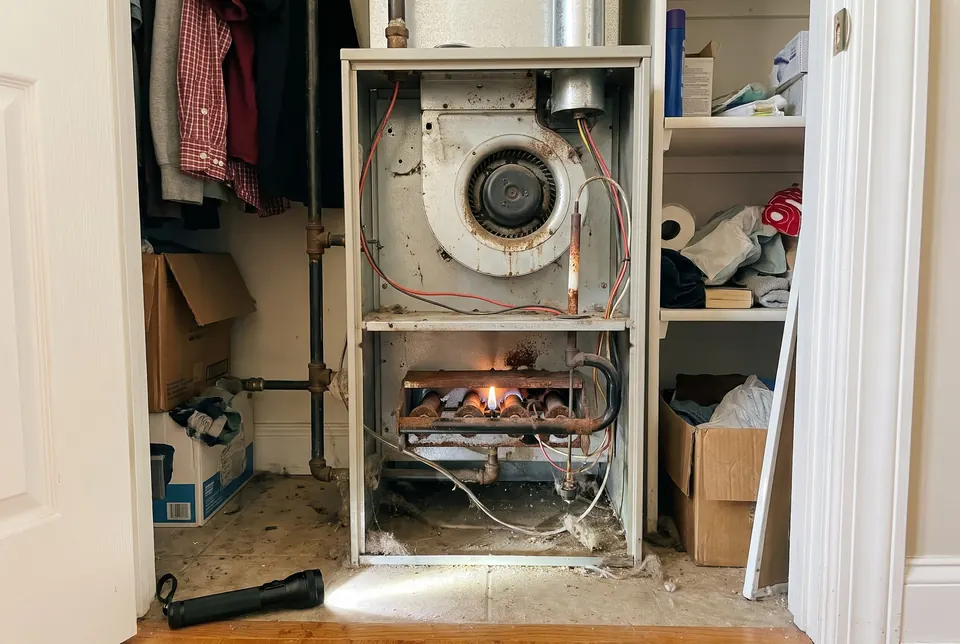
What should you do first if your furnace stops working?
Start with three quick checks that Carrier lists: the thermostat mode and setpoint, the furnace power switch, and the air filter. Carrier recommends checking the filter monthly and replacing many 1-inch filters every 30 to 90 days. Make sure supply and return vents are open, because blocked vents can cause overheating that trips the limit switch.
If the furnace still will not heat, stop there. Carrier says not to attempt to diagnose or repair gas, oil, combustion, or electrical components yourself, and Trane advises against resetting a tripped furnace breaker and calling an HVAC professional instead. Call (916) 712-7030 to talk with a local HVAC technician.
What do you do if you smell gas or suspect carbon monoxide?
Leave the home right away and call 911 from outside, then PG&E at 1-800-743-5000, as PG&E advises. Carrier says not to operate electrical switches or try to relight a furnace if you smell natural gas.
Carrier says if you suspect carbon monoxide, leave the home and contact emergency or utility services. It lists a cracked heat exchanger as a major repair that may call for weighing repair against replacement. Do not keep running a furnace you suspect is leaking combustion gases.
What are the most common furnace repairs?
Most no-heat calls on a gas furnace come from a short list of parts. Trane and Carrier both point to the ignition system and the safety switches.
- Flame sensor: Carrier says a furnace can stop suddenly if the flame sensor becomes dirty, and Trane lists a dirty or faulty sensor among the causes of ignition failure. Trane says you should not clean or replace it yourself.
- Igniter: Carrier says igniters wear out from frequent cycling. Trane notes furnaces made since 2010 use an electronic igniter, while older ones may have a standing pilot light.
- Pressure switch: Fixr lists it among common furnace repairs.
- Limit switch: it shuts the burners down when the furnace overheats, often from a clogged filter or closed vents.
- Blower motor: if the burners light but little air moves, the blower may be failing.
- Dirty burners or gas supply: Trane lists dirty burners and a closed gas valve among the causes of ignition failure.
How much does furnace repair cost?
Fixr's October 2026 guide puts typical furnace repairs at $150 to $600 nationally, with an average of $350 to $400, and heat exchanger replacement at $1,000 to $3,500 or more. This Old House lists blower motors at $170 to $2,400 and professional installation labor at $150 to $250 (updated August 2026). These are national ranges, not Sacramento quotes.
Fixr says emergency or after-hours calls cost 50% to 100% more than standard rates. If your furnace dies on a cold night, ask what the after-hours charge will be before the technician is dispatched.
Should you repair or replace an old furnace?
This Old House says furnaces typically last 15 to 25 years and uses a 50% rule: repair if the fix costs less than half the price of a new furnace, and consider replacing if it costs more or involves an expensive part such as the heat exchanger or control board. It lists the average full furnace replacement cost at $4,799, with gas furnaces at $3,800 to $10,000.
In SMUD territory, replacing a gas furnace with a heat pump can earn a rebate. As of November 2026, SMUD lists $3,000 for a variable-stage heat pump and $2,000 for a two-stage model (15.2 SEER2 minimum) that replaces gas heat, with funding limited and a SMUD Contractor Network installer required. Ask for repair and replacement quotes in writing so you can compare.
What license should a furnace repair contractor hold?
Furnace work falls under the CSLB's C-20 classification for warm-air heating, ventilating, and air-conditioning. Look up the license number on the CSLB license page before the visit, confirm the status is active, and match the person at your door to the license record and a photo ID. CSLB says a down payment generally cannot exceed 10% of the contract or $1,000, whichever is less.
| Repair | Typical national range | Notes |
|---|---|---|
| Typical furnace repair | $150 to $600; average $350 to $400 | Fixr |
| Igniter | $150 to $400 | Wears out from frequent cycling (Carrier) |
| Flame sensor | $100 to $300 | Do not DIY (Trane) |
| Pressure switch | $200 to $400 | Fixr |
| Heat exchanger replacement | $1,000 to $3,500+ | Often leads to full replacement (Fixr) |
| After-hours call | 50% to 100% above standard rates | Fixr |
Need an AC repair technician in the Sacramento area?
Call to talk to a local AC repair technician, describe the job and get a quote before any work starts. The call is free.
Frequently asked questions
Why does my furnace turn on and then shut off?
Is it safe to relight my furnace pilot light myself?
How much does furnace repair cost in Sacramento?
When is a furnace too old to repair?
Who can repair a gas furnace in California?
Sources
- Furnace Troubleshooting Guide — Carrier
- Furnace Not Igniting? Find Out Why and What to Do — Trane
- Gas safety — Pacific Gas and Electric Company (PG&E)
- HVAC Service Repair Costs (2026 Guide), updated October 22, 2026 — Fixr
- What Is the Cost of a Furnace Blower Motor? (2026 Guide) — This Old House
- How Much Does a New Furnace Cost? (2026) — This Old House
- Heating and cooling rebates — Sacramento Municipal Utility District (SMUD)
- C-20 Warm-Air Heating, Ventilating and Air-Conditioning Contractor classification — Contractors State License Board (CSLB)
- Check a License or HIS Registration — Contractors State License Board (CSLB)
- How do I find the right licensed contractor? — Contractors State License Board (CSLB)