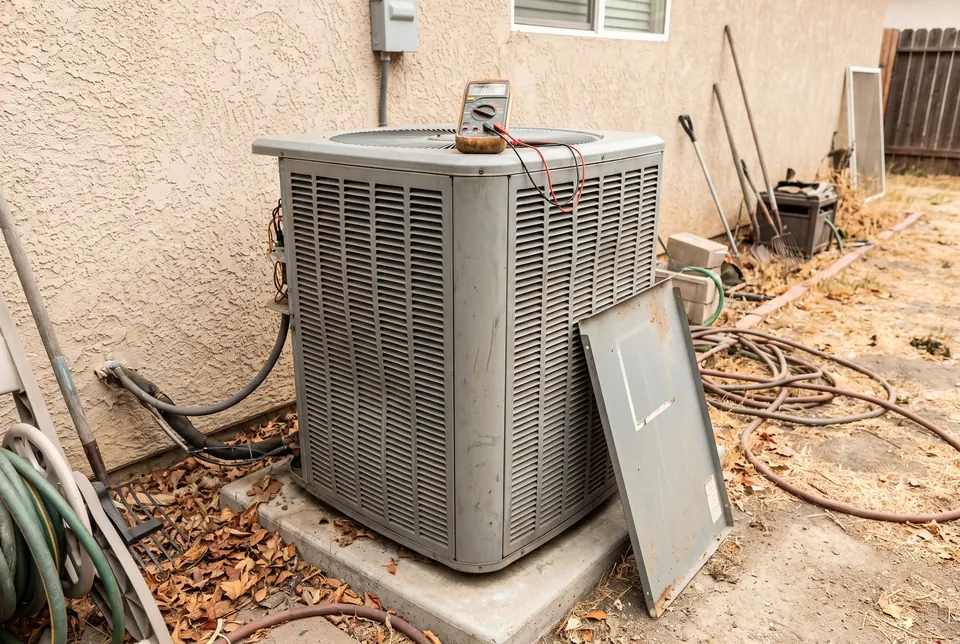
What usually fails on a Carrier air conditioner?
Carrier's parts guide gives typical lifespans and warning signs for the parts that most often need service. These are Carrier's ranges, not promises, and installation, climate, and maintenance change the real number.
The pattern is common to most central air conditioners: the electrical parts in the outdoor unit wear first, and the sealed refrigerant circuit lasts longer unless there is a leak.
- Capacitor (about 10 to 20 years): humming, hard starting, or short cycling.
- Contactor (about 5 to 15 years): the AC will not start, buzzes, or runs intermittently.
- Condenser fan motor (about 10 to 15 years): the outdoor fan is not spinning, the unit overheats, or it makes unusual noise.
- Compressor (about 10 to 15+ years): the AC runs but does not cool, trips the breaker, or is noisy.
- Evaporator coil (about 10 to 15 years): reduced cooling, ice, or refrigerant leaks.
What does Carrier say to check before calling?
Carrier says an AC that stops cooling is most often caused by a tripped breaker, a wrong thermostat setting, or a clogged filter, so check those first. If you see ice, it says to shut the system off immediately to prevent compressor damage. Issues with capacitors, motors, and compressors involve high-voltage parts, and Carrier says not to troubleshoot electrical issues yourself. It says low refrigerant is usually due to a leak and not to try to fix refrigerant issues yourself.
How does Carrier's warranty registration work?
Carrier's warranty page says to register within 90 days of installation. With timely registration you can choose either a 10-year parts-only limited warranty or a 5-year parts plus 3-year labor limited warranty. The labor option requires that your installing dealer participates in the program. If you register late or not at all, the standard 5-year parts-only limited warranty applies, with no labor coverage.
Carrier says that in jurisdictions where registration cannot be required, coverage automatically becomes the 10-year parts warranty, which you can change to the labor option within the first 90 days. The page does not name California, so check your warranty certificate. New residential construction installations are not eligible for the Consumer Choice program. Ask the installer who will register the unit, and keep the serial number.
What is R-454B, and does it affect repairs?
Carrier markets R-454B as Puron Advance. It says the refrigerant has a global warming potential of 466 versus 2,088 for R-410A, and it is classed A2L, meaning mildly flammable, where R-410A is A1. Carrier says R-454B is not a drop-in replacement: an existing R-410A system should not simply be charged with it, because components, controls, and safety features are designed for the specified refrigerant.
Carrier says its Puron Advance products include a leak detection system that can activate a fan to disperse refrigerant, and that equipment should be installed and serviced by a qualified HVAC professional familiar with A2L equipment, following the manufacturer's pressure, charging, and service documentation. Check your unit's nameplate to see which refrigerant it uses.
How much does Carrier AC repair cost?
Repair prices are set by the part and the contractor, not the logo on the unit. National 2026 guides put most AC repairs at $150 to $650 (This Old House and Fixr). A capacitor runs $80 to $400, a contactor $100 to $450, and an evaporator coil $627 to $2,700 (This Old House). R-22 recharge costs are higher than R-410A. See the cost table below, and ask for an itemized written estimate.
How do you check a contractor who works on Carrier equipment?
The license is what the state requires, not a brand badge. Ask for the contractor's CSLB number, look it up on the CSLB license page, and confirm an active C-20 license. For refrigerant work, ask about an EPA Section 608 credential. If your warranty depends on how the repair is done, ask the contractor to use parts approved for your model and put the part numbers on the estimate.
| Repair | Typical national range | Carrier lifespan guide |
|---|---|---|
| Capacitor | $80 to $400 | About 10 to 20 years |
| Contactor or relay | $100 to $450 | About 5 to 15 years |
| Evaporator coil | $627 to $2,700 | About 10 to 15 years |
| Compressor | $1,000 to $3,000+ | About 10 to 15+ years |
Need an AC repair technician in the Sacramento area?
Call to talk to a local AC repair technician, describe the job and get a quote before any work starts. The call is free.
Frequently asked questions
How long do I have to register my Carrier AC warranty?
What is Carrier Puron Advance?
Can a technician add R-454B to my older Carrier AC?
Why is my Carrier AC humming but not starting?
Does Carrier cover labor on a repair?
Sources
- Carrier residential warranty: registration and Consumer Choice coverage — Carrier
- What is R-454B Refrigerant? (Puron Advance) — Carrier
- Air Conditioner Parts Guide — Carrier
- Troubleshoot an Air Conditioner: 6 Steps to Fix an AC Not Working — Carrier
- Air Conditioner Repair Cost (2026 Pricing), updated March 16, 2026 — This Old House
- How Much Does AC Capacitor Replacement Cost? (2026 Prices), updated April 7, 2026 — This Old House
- How Much Does Evaporator Coil Replacement Cost?, updated April 6, 2026 — This Old House
- AC Repair Cost: Common Issues & When to Replace (2026), updated August 4, 2026 — Fixr
- Section 608 Technician Certification Requirements — U.S. Environmental Protection Agency (EPA)
- C-20 Warm-Air Heating, Ventilating and Air-Conditioning Contractor classification — Contractors State License Board (CSLB)
- Check a License or HIS Registration — Contractors State License Board (CSLB)